Data-Driven Soil Sensors: 18% More Accurate Fertilizer by 2026
Anúncios
Data-driven soil sensors are poised to significantly enhance fertilizer application accuracy by 18% by the 2026 growing season, optimizing nutrient delivery and promoting sustainable agricultural practices.
Anúncios
As we approach the 2026 growing season, the agricultural landscape is witnessing a profound transformation, spearheaded by innovations like data-driven soil sensors. These sophisticated tools are not just gadgets; they represent a fundamental shift in how farmers approach nutrient management, promising an impressive 18% enhancement in fertilizer application accuracy. This leap forward is set to redefine efficiency, sustainability, and profitability in farming operations across the United States.
The evolution of soil sensing technology
The journey of soil sensing technology has been one of continuous innovation, moving from rudimentary soil tests to highly sophisticated, real-time data collection systems. Early methods, while foundational, often provided a snapshot rather than a dynamic understanding of soil conditions. Today, however, we are equipped with sensors that offer granular insights, transforming how farmers interact with their most vital resource: the soil.
Anúncios
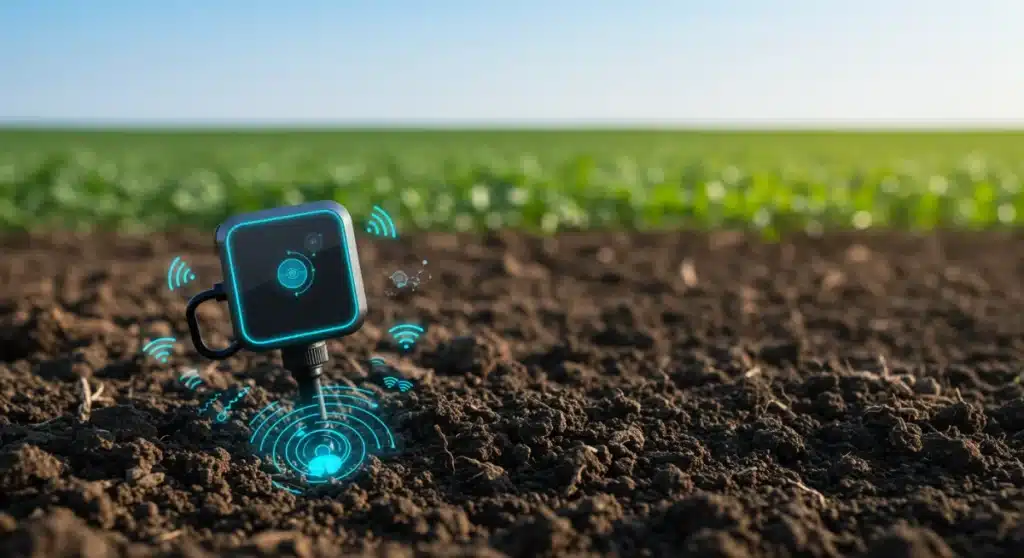
These modern sensors leverage a variety of principles, including electrical conductivity, electromagnetic induction, and optical reflectance, to measure critical parameters. This includes everything from moisture content and temperature to pH levels and the concentration of essential nutrients like nitrogen, phosphorus, and potassium. The evolution has been driven by the need for more precise and timely information, directly impacting decision-making on the farm.
From static tests to dynamic insights
- Real-time data: Traditional soil sampling provided data points at specific intervals; modern sensors deliver continuous, real-time updates.
- Spatial variability: Sensors can map variations across a field, allowing for zone-specific management rather than uniform application.
- Predictive analytics: Advanced algorithms process sensor data to predict nutrient uptake and crop demand, preventing deficiencies or excesses.
The integration of these technologies into farming practices marks a significant milestone. It allows for a proactive rather than reactive approach to soil health and nutrient management, laying the groundwork for the substantial improvements in fertilizer application accuracy we anticipate by 2026.
In essence, the evolution of soil sensing has empowered farmers with an unprecedented level of detail about their fields. This deep understanding is crucial for optimizing every input, especially fertilizers, which represent a significant cost and environmental consideration.
How data-driven sensors enhance fertilizer accuracy
The core principle behind the enhanced accuracy of fertilizer application through data-driven sensors lies in their ability to provide hyper-localized and real-time information. Unlike traditional methods that rely on broad averages, these sensors pinpoint specific needs at various points across a field, enabling variable-rate application that truly matches crop requirements.
By continuously monitoring soil conditions, sensors can detect nutrient deficiencies or excesses as they develop, allowing for immediate corrective action. This precision minimizes waste, reduces environmental impact, and ensures that each plant receives the optimal amount of nutrients for healthy growth. The result is a more efficient use of resources and healthier, more productive crops.
Precision nutrient delivery mechanisms
- Zone-specific application: Sensors map soil nutrient levels, enabling applicators to vary fertilizer rates according to the specific needs of different zones within a field.
- Timing optimization: Real-time data helps determine the best windows for fertilizer application, aligning with crop growth stages and weather conditions for maximum uptake.
- Reduced leaching and runoff: By applying only what is needed, the risk of excess nutrients leaching into groundwater or running off into surface water is significantly reduced.
The synergy between data collection and application machinery is what truly drives this accuracy. Sensor data feeds directly into precision farming equipment, which then adjusts fertilizer output on the fly. This seamless integration eliminates guesswork and ensures that every pound of fertilizer applied contributes directly to crop health and yield.
Ultimately, the enhanced accuracy translates into tangible benefits: healthier crops, higher yields, and a more sustainable agricultural footprint. This level of control over nutrient application was once aspirational but is now a reality thanks to these advanced sensor systems.
Key technologies integrating with soil sensors
The true power of data-driven soil sensors is unlocked when they are integrated with other cutting-edge agricultural technologies. This synergy creates a comprehensive ecosystem that not only collects data but also processes it, makes informed decisions, and executes precise actions. The combination of these technologies forms the backbone of modern precision agriculture.
From satellite imagery providing macro-level insights to AI-driven analytical platforms that interpret complex data sets, the integration points are numerous and impactful. These interconnected systems work in concert to give farmers an unparalleled view of their fields and the tools to manage them with unprecedented efficiency.
Complementary agricultural technologies
- GPS and GIS mapping: Provide precise location data for sensors and enable the creation of detailed field maps for variable-rate application.
- AI and machine learning: Analyze vast amounts of sensor data to identify patterns, predict future needs, and optimize decision-making for fertilizer application.
- Variable-rate technology (VRT): Specialized equipment that automatically adjusts the rate of fertilizer application based on real-time data from sensors and mapping.
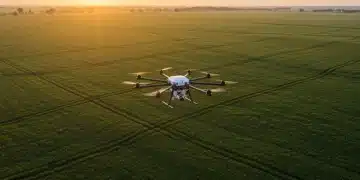
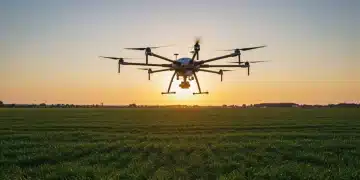
- Drones and satellite imagery: Offer aerial views of crop health, identifying areas of stress or vigorous growth that can be correlated with soil sensor data.
The seamless flow of information between these technologies is critical. Data from soil sensors might indicate a localized nitrogen deficiency, which is then cross-referenced with drone imagery showing stunted growth in that same area. An AI system then processes this combined data to generate a precise prescription map, which is subsequently executed by a VRT-equipped tractor.
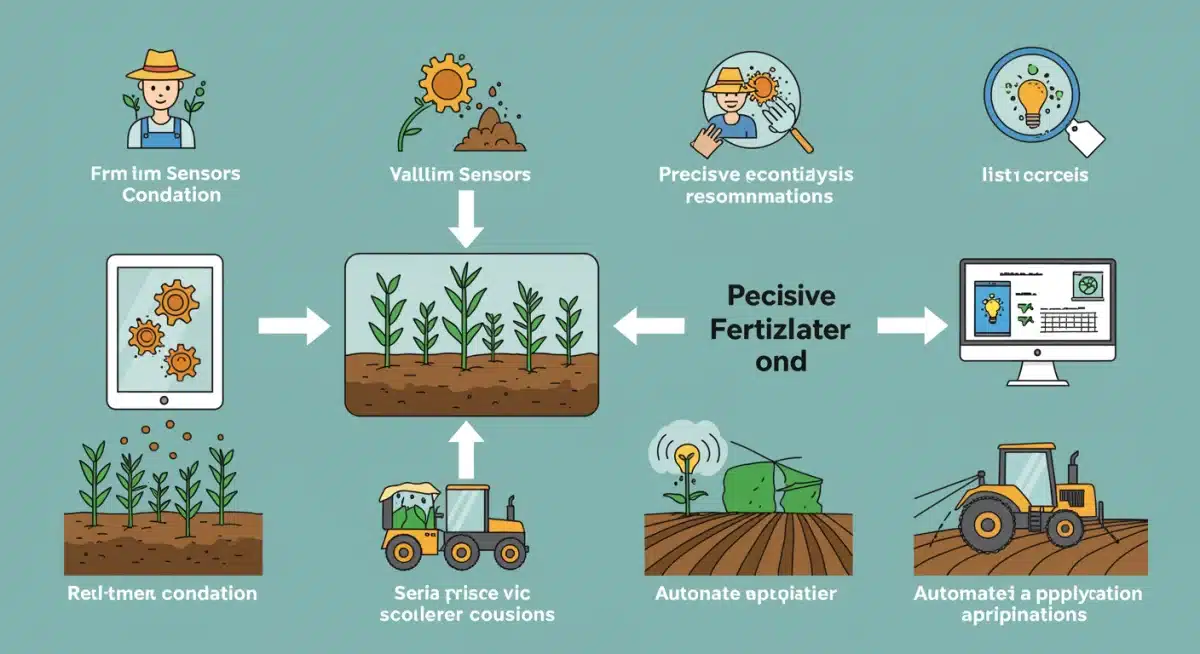
This integrated approach ensures that decisions are data-backed and actions are meticulously executed, solidifying the gains in fertilizer application accuracy. It’s a holistic system designed to optimize every aspect of crop management.
Anticipated impact for the 2026 growing season
Looking ahead to the 2026 growing season, the widespread adoption of data-driven soil sensors is expected to yield significant and measurable improvements across various facets of agriculture. The projected 18% increase in fertilizer application accuracy is not just a statistic; it represents a cascade of benefits for farmers, the environment, and the broader food system.
This enhanced precision will translate directly into optimized resource utilization, leading to both economic gains for farmers and reduced ecological footprints. The impacts will be felt in terms of increased yields, improved crop quality, and a more resilient agricultural sector capable of meeting future demands.
Projected benefits and outcomes
- Increased profitability: Farmers will save on fertilizer costs by applying only what is necessary, while simultaneously boosting yields through optimized nutrient delivery.
- Environmental stewardship: Reduced overuse of fertilizers means less nutrient runoff and leaching, protecting water quality and supporting healthier ecosystems.
- Enhanced crop health and resilience: Precisely fed crops are stronger, more resistant to disease and pests, and better equipped to handle environmental stresses.
Beyond these immediate impacts, the refinement of fertilizer application accuracy also contributes to a more sustainable food supply chain. By maximizing the efficiency of nutrient use, agriculture can produce more food with fewer inputs, addressing global food security concerns in an environmentally responsible manner.
The 2026 growing season stands as a benchmark for what precision agriculture can achieve. It signifies a future where technology and ecological responsibility converge, leading to a more productive and sustainable farming model.
Overcoming challenges in sensor adoption
Despite the undeniable benefits, the path to widespread adoption of data-driven soil sensors is not without its hurdles. Farmers face various challenges, from the initial investment costs to the complexities of integrating new technologies into existing operations. Addressing these issues is crucial for realizing the full potential of these transformative tools.
Education, infrastructure development, and supportive policies will play pivotal roles in accelerating the adoption rate. It’s a collaborative effort involving technology providers, agricultural extension services, and government bodies to ensure that these innovations are accessible and practical for all farmers.
Common adoption barriers and solutions
- High initial cost: Government subsidies, financing options, and lease programs can make sensors more accessible to small and medium-sized farms.
- Technical complexity: User-friendly interfaces, comprehensive training programs, and on-demand technical support can ease the learning curve.
- Data management and interpretation: AI-powered platforms with intuitive dashboards and expert advisory services can help farmers make sense of complex data.
- Connectivity issues: Expansion of rural broadband infrastructure is essential to support real-time data transmission from remote fields.
Overcoming these challenges requires a layered approach. It’s not just about selling a product but about providing a complete solution that includes support, training, and integration assistance. As these barriers are systematically addressed, the benefits of data-driven soil sensors will become accessible to a broader farming community.
Ultimately, the success of these technologies hinges on their ability to deliver tangible value to farmers in a way that is both manageable and economically viable. The industry is actively working on solutions to make this a reality.
The future outlook: beyond 2026
While the 2026 growing season marks a significant milestone for data-driven soil sensors and fertilizer accuracy, the journey of innovation in precision agriculture is far from over. The future promises even more sophisticated technologies, deeper insights, and a continued evolution towards hyper-optimized and sustainable farming practices.
We can anticipate advancements in sensor miniaturization, enhanced battery life, and even more robust data analytics capabilities, potentially leading to fully autonomous nutrient management systems. The integration with robotics and advanced AI will further refine the precision, pushing accuracy levels beyond current projections.
Emerging trends and long-term vision
- Pervasive sensing networks: Denser deployment of smaller, more affordable sensors providing even finer-grained data across entire landscapes.
- AI-driven autonomous systems: Fully automated systems that can analyze soil data, predict crop needs, and apply fertilizers without direct human intervention.
- Biometric crop monitoring: Sensors that not only monitor soil but also directly assess plant health and nutrient uptake, closing the feedback loop.
- Integration with climate models: Predictive models that combine soil data with weather forecasts to optimize nutrient strategies for changing environmental conditions.
The long-term vision is one of an agricultural system that is not only highly productive but also profoundly sustainable and resilient. Data-driven soil sensors are a cornerstone of this vision, continuously evolving to meet the complex demands of feeding a growing global population while protecting our planet’s resources.
The innovations we see today are merely a preview of the transformative changes yet to come, establishing a trajectory for agriculture that is increasingly intelligent, efficient, and environmentally conscious.
| Key Aspect | Description |
|---|---|
| Accuracy Goal 2026 | Targeting an 18% increase in fertilizer application accuracy by the 2026 growing season. |
| Sensor Functionality | Provides real-time, localized data on soil moisture, pH, and nutrient levels for precise management. |
| Integrated Technologies | Combines with GPS, AI, VRT, and aerial imagery for comprehensive farm optimization. |
| Benefits | Leads to higher yields, reduced costs, and significant environmental protection. |
Frequently asked questions about soil sensors
Data-driven soil sensors are advanced devices that collect real-time information about soil conditions, such as moisture, temperature, pH, and nutrient levels. This data is then used to make precise decisions for agricultural practices, particularly fertilizer application, optimizing resource use and crop health.
By providing localized, real-time data, sensors enable variable-rate fertilizer application, ensuring nutrients are delivered precisely where and when needed. This eliminates over-application in some areas and under-application in others, leading to more efficient use and reduced waste. It’s about feeding the plant, not just the field.
Soil sensors collect a wide range of data, including soil moisture content, temperature, electrical conductivity (EC), pH, and concentrations of key nutrients like nitrogen, phosphorus, and potassium. Some advanced sensors can also measure organic matter content and soil respiration, offering a holistic view of soil health.
The primary environmental benefit is the significant reduction in nutrient runoff and leaching. By optimizing fertilizer application, sensors prevent excess chemicals from entering waterways, protecting aquatic ecosystems and ensuring cleaner water sources. This contributes directly to more sustainable agriculture and eco-friendly farming practices.
While initial costs can be a barrier for smaller farms, the industry is moving towards more affordable and scalable solutions. Government subsidies, equipment leasing programs, and user-friendly platforms are making these technologies increasingly accessible, ensuring that farms of all sizes can benefit from precision agriculture.
Conclusion
The advent of data-driven soil sensors marks a pivotal moment in agricultural history, promising a future where fertilizer application is not just efficient but exceptionally precise. The projected 18% increase in accuracy by the 2026 growing season is a testament to the transformative power of these technologies. By fostering a deeper understanding of soil conditions and enabling hyper-localized nutrient delivery, these sensors are driving significant advancements in both economic profitability for farmers and environmental sustainability for our planet. As we continue to refine these systems and overcome adoption challenges, the trajectory for agriculture is set towards an increasingly intelligent, resilient, and productive future.