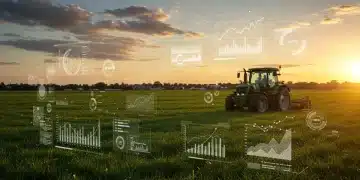
Robotics in Harvesting: Reducing US Farm Labor Costs by 25% by 2026
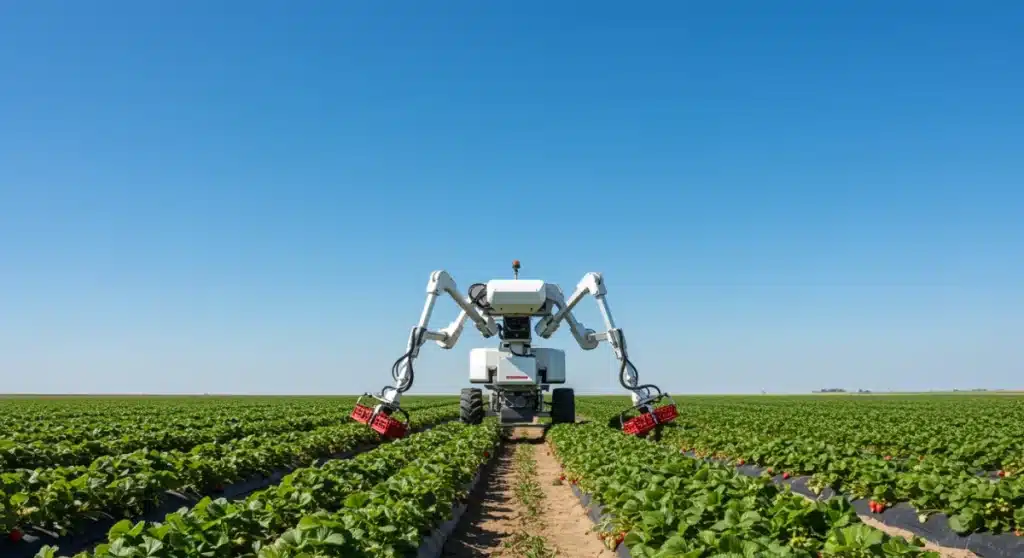
Advanced robotics harvesting labor costs are poised to revolutionize US agriculture, with automated systems projected to reduce farm labor expenses by 25% by 2026, significantly improving farmer profitability and operational efficiency.
The agricultural landscape in the United States is on the cusp of a profound transformation, driven by the rapid advancements in robotics and automation. For US farmers, the promise of these innovations isn’t just about futuristic machinery; it’s about a tangible, significant impact on their bottom line. By 2026, experts project that the widespread adoption of robotics in harvesting will lead to a remarkable 25% reduction in labor costs, a financial shift that could redefine the economics of farming. This article delves into how these automated systems are achieving such efficiencies and the far-reaching financial implications for American agriculture.
The Rising Imperative for Automated Harvesting in the US
The US agricultural sector has long grappled with escalating labor costs and persistent shortages, challenges that have intensified in recent years. Manual labor for harvesting certain crops is not only expensive but also increasingly difficult to secure, creating bottlenecks that impact farm productivity and profitability. This growing pressure has accelerated the search for sustainable, long-term solutions.
Automation, particularly through advanced robotics, has emerged as the most viable answer. Farmers are looking to these technologies not just to replace human labor, but to enhance overall operational efficiency, reduce crop waste, and improve the consistency of harvest quality. The shift towards automated harvesting is no longer a luxury but a strategic necessity for many US farms aiming to remain competitive in a global market.
Labor Shortages and Wage Pressures
The agricultural industry faces unique labor dynamics. A shrinking pool of seasonal workers, coupled with rising minimum wages and increased regulatory burdens, places immense financial strain on farmers. These factors directly contribute to higher operational costs, making it harder for farms to achieve adequate profit margins, especially for labor-intensive specialty crops.
- Decreased availability of migrant workers.
- Increased hourly wages and benefits.
- Complex immigration and labor regulations.
- The physical demands of farm work deterring new entrants.
Understanding these underlying pressures is crucial to appreciating why robotic solutions are gaining such traction. They offer a pathway to mitigate these risks and stabilize a critical aspect of farming operations.
The imperative for automated harvesting is rooted in economic reality. Farms must adapt to survive and thrive, and robotics provides a powerful tool for this adaptation. By addressing the core challenges of labor, these systems pave the way for a more resilient and efficient agricultural future.
Technological Advancements Driving Robotic Efficiency
The leap in robotic harvesting capabilities is not accidental; it’s the result of decades of intense research and development in various technological fields. Modern agricultural robots are far more sophisticated than their predecessors, integrating artificial intelligence, advanced sensor fusion, and precision mechanics to perform tasks with unprecedented accuracy and speed.
These machines are specifically designed to handle the delicate nature of fresh produce, minimizing damage while maximizing yield. Their ability to operate around the clock, in varying weather conditions, further amplifies their efficiency gains compared to traditional manual labor.
Artificial Intelligence and Machine Vision
At the heart of many harvesting robots is advanced AI, particularly in machine vision systems. These systems can identify ripe fruits and vegetables, differentiate between healthy and diseased plants, and even assess optimal picking points. This level of discernment mimics, and often surpasses, human capabilities in repetitive, high-volume tasks.
- Real-time ripeness detection for selective harvesting.
- Identification of pests and diseases to prevent spread.
- Optimal path planning for efficient navigation through fields.
- Data collection for yield prediction and crop management.
The continuous learning capabilities of AI mean that these robots become more efficient and accurate over time, adapting to new crop varieties and environmental conditions. This self-improvement aspect ensures long-term value for farmers.
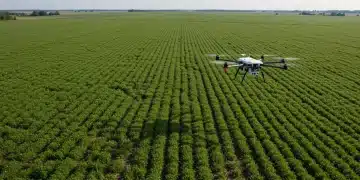
Beyond AI, the integration of LIDAR, GPS, and various spectral sensors allows robots to create highly detailed maps of fields and individual plants. This spatial awareness enables precise navigation and targeted actions, ensuring that resources are used optimally and every harvestable item is accounted for. The synergy of these technologies creates a robust and adaptable harvesting platform.
Quantifying the 25% Labor Cost Reduction by 2026
The projection of a 25% reduction in labor costs by 2026 is based on several key factors, including the accelerating adoption rate of robotic systems, the increasing efficiency and affordability of these technologies, and the direct displacement of manual labor in specific harvesting tasks. This reduction is not uniform across all crops or farm sizes but represents an aggregate impact across the US agricultural sector.
For many labor-intensive crops like strawberries, tomatoes, and apples, where manual picking accounts for a significant portion of production costs, the impact will be even more pronounced. The financial models driving this forecast consider both direct wage savings and indirect benefits such as reduced training, supervision, and compliance costs.
Direct Wage Savings
The most straightforward component of cost reduction comes from replacing human pickers with autonomous robots. While the initial investment in robotics can be substantial, the long-term operational costs are significantly lower. Robots do not require wages, benefits, or overtime pay, and their maintenance costs, while present, are predictable.
Consider a farm that requires dozens or even hundreds of seasonal workers during peak harvest. A fleet of robotic harvesters can perform the same work with a fraction of the human oversight, leading to substantial savings. These savings accumulate rapidly, especially for farms with multiple harvest cycles per year.
Increased Efficiency and Reduced Waste
Beyond direct wage savings, robots contribute to cost reduction through increased efficiency and reduced crop waste. Their precision harvesting minimizes damage to crops, ensuring a higher percentage of marketable produce. Furthermore, their ability to operate continuously, day and night, means crops can be harvested at their optimal ripeness, reducing spoilage and maximizing yield.
This efficiency translates directly into greater revenue per acre, effectively lowering the per-unit cost of production. The combination of lower labor inputs and higher marketable output creates a powerful economic advantage for farms that embrace these technologies.
Case Studies: Early Adopters and Their Successes
While the 25% cost reduction is a future projection, many early adopters in the US are already experiencing significant benefits from integrating robotic harvesting systems. These pioneering farms serve as crucial examples, demonstrating the tangible impact of automation on profitability and operational resilience. Their successes are paving the way for wider industry adoption.
From large-scale commercial operations to smaller, specialized farms, the common thread is a strategic investment in technology to overcome persistent labor challenges and enhance competitive advantage. These case studies provide real-world validation for the financial forecasts.
Strawberry Harvesting in California
California’s strawberry industry, notorious for its high labor demands, has been an early testing ground for robotic harvesters. Companies like Harvest CROO Robotics have developed autonomous pickers that can identify and gently harvest ripe strawberries. Farms utilizing these robots report a significant decrease in reliance on manual labor, leading to substantial cost savings per acre.
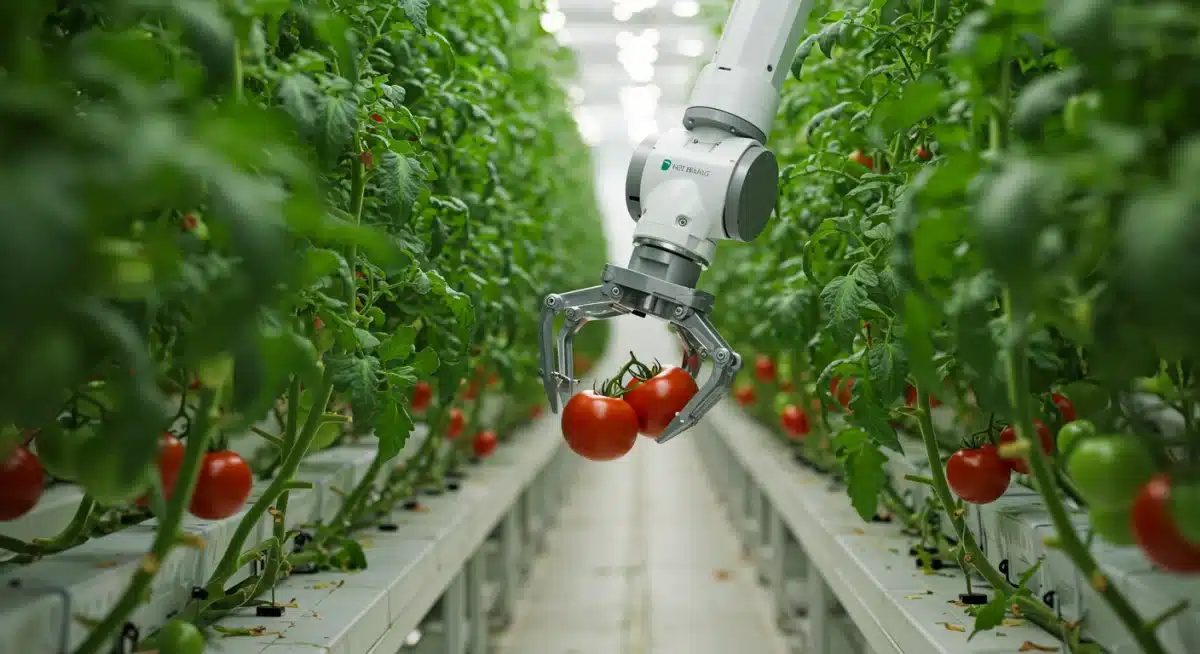
One prominent farm, for instance, reported a 15% reduction in harvesting costs within the first year of deploying a small fleet, alongside a noticeable improvement in fruit consistency and reduced bruising. This initial success signals a promising trajectory towards the broader 25% cost reduction target.
Orchard Automation in Washington State
The apple and cherry orchards of Washington State are also seeing a transformation. Robotic platforms equipped with advanced vision systems are now capable of selectively picking fruit, reducing the need for large picking crews. These systems are particularly valuable for high-value tree crops where careful handling is paramount.
- Precision picking reduces fruit damage by up to 10%.
- Extended harvesting windows due to 24/7 operation.
- Data collection on individual tree yield and health.
- Reduced worker compensation claims related to ladder work.
These examples illustrate that while the technology is still evolving, its practical application is already delivering measurable financial benefits, reinforcing the projections for widespread cost reductions in the coming years.
Challenges and the Path to Widespread Adoption
Despite the immense potential and early successes, the widespread adoption of robotics in harvesting faces several challenges. These include the high initial capital investment, the need for specialized technical expertise, and the adaptability of current farm infrastructure. Overcoming these hurdles is crucial for realizing the projected 25% labor cost reduction across the US agricultural sector.
However, the industry is actively working on solutions, from financing models to educational programs, to accelerate the transition. Collaboration between technology developers, agricultural institutions, and government bodies is key to fostering an environment conducive to automation.
Initial Investment and ROI
The upfront cost of a robotic harvesting system can be a significant barrier for many farmers, especially smaller operations. A single advanced harvester can cost hundreds of thousands of dollars. Farmers need clear demonstrations of return on investment (ROI) to justify such substantial capital expenditures.
Financial incentives, lease-to-own programs, and shared-use models are emerging to make these technologies more accessible. As production scales and technology matures, unit costs are also expected to decrease, further improving the ROI for future adopters.
Integration and Technical Expertise
Integrating robotic systems into existing farm operations requires technical expertise that may not be readily available on every farm. This includes understanding software, performing routine maintenance, and troubleshooting issues. Training programs and accessible technical support are vital for smooth adoption.
- Developing standardized interfaces for farm management systems.
- Providing comprehensive training for farm staff.
- Establishing robust local support networks for maintenance and repairs.
- Ensuring interoperability with other farm technologies.
Addressing these challenges systematically will pave the way for a more seamless integration of robotics into the daily operations of US farms, accelerating the journey towards the projected cost savings.
The Broader Financial Impact on US Agriculture
The 25% reduction in labor costs due to robotics in harvesting will have a ripple effect across the entire US agricultural economy. Beyond direct savings, it will influence crop prices, international competitiveness, and the overall structure of farm employment. This financial impact extends far beyond individual farm gates, shaping the future trajectory of American food production.
Farmers who successfully integrate these technologies will gain a significant competitive edge, allowing them to produce food more efficiently and at a lower cost, benefiting both producers and consumers in the long run.
Enhanced Competitiveness and Market Stability
Lower production costs stemming from automated harvesting will make US agricultural products more competitive in both domestic and international markets. This can help stabilize prices for consumers and provide a more predictable revenue stream for farmers, reducing volatility driven by labor market fluctuations.
Furthermore, increased efficiency can lead to greater output, allowing US agriculture to meet growing global food demands more effectively. This strategic advantage is crucial in an increasingly interconnected world food system.
Shifting Labor Demographics and New Opportunities
While robotics will reduce the demand for manual harvesting labor, it will concurrently create new types of jobs requiring different skill sets. There will be an increased need for technicians to operate, maintain, and repair robotic systems, as well as data analysts to interpret the vast amounts of information generated by automated processes.
- Creation of high-skilled robotics technician roles.
- Growth in agricultural data science and AI specialists.
- Increased demand for engineers specializing in farm automation.
- Opportunities for training and upskilling the existing agricultural workforce.
This shift represents an evolution rather than a complete displacement, transforming agricultural work into a more technology-driven and skilled profession, ultimately contributing to a more advanced and sustainable agricultural workforce.
| Key Aspect | Brief Description |
|---|---|
| Labor Cost Reduction | Projected 25% decrease in US farm labor costs by 2026 due to robotic harvesting. |
| Driving Technologies | AI, machine vision, and advanced sensors enable precise and efficient automated picking. |
| Economic Impact | Increases farm profitability, competitiveness, and reduces crop waste, leading to higher yields. |
| Adoption Challenges | High initial investment and need for technical expertise are current barriers. |
Frequently Asked Questions About Robotic Harvesting
Robotic harvesting is currently most effective for specialty crops that are labor-intensive and require delicate handling, such as strawberries, tomatoes, apples, and peppers. Advancements are continuously expanding capabilities to other fruits and vegetables, making more crops amenable to automation in the near future.
The initial investment for a robotic harvesting system can range from tens of thousands to several hundred thousand dollars, depending on the scale, complexity, and specific crop requirements. While substantial, this cost is often offset by significant long-term savings in labor and increased efficiency, leading to a favorable return on investment.
Robotic harvesting is expected to reduce the demand for manual labor in specific tasks, but it also creates new job opportunities. There will be an increased need for skilled technicians, engineers, and data analysts to operate, maintain, and manage these advanced systems, shifting the agricultural workforce towards more technical roles.
Yes, one of the significant advantages of robotic harvesters is their ability to operate continuously, day and night, without fatigue. This capability allows for extended harvesting windows, ensuring crops are picked at optimal ripeness and maximizing yield, contributing directly to the projected labor cost reductions and increased efficiency.
Artificial Intelligence (AI) is crucial for robotic harvesting, enabling machines to perceive, analyze, and make decisions. AI-powered machine vision systems identify ripe produce, assess quality, and guide robotic arms for precise picking. This intelligence allows robots to adapt to varied field conditions and continuously improve their harvesting efficiency and accuracy over time.
Conclusion
The trajectory for US agriculture is clear: robotics in harvesting are set to fundamentally alter the financial landscape. The projected 25% reduction in labor costs by 2026 is not merely an optimistic forecast but a tangible outcome driven by relentless technological innovation and the pressing economic realities faced by farmers. While challenges such as initial investment and technical integration remain, the demonstrable benefits in efficiency, yield, and overall profitability are compelling more farms to embrace this automated future. As these systems become more sophisticated and accessible, they will not only secure the competitiveness of American agriculture but also foster a new era of sustainable and high-tech farming, transforming the very nature of food production.